


The votes have been cast, the political ads are finally leaving our screens, and while a few final counts are still being finalized, we now have a much clearer picture of what Washington will look like for the next couple of years.
Leading up to the election, we believed this cycle was unlikely to create the level of market volatility we've seen during some previous midterm years. Historically, the S&P 500 has experienced an average decline of about 17% before midterm elections. This year, the pullback was closer to 9%. While the voter response initially created some movement in overnight futures markets, investors appeared to welcome the clarity that came with the results.
A big reason markets have remained relatively stable is that investors largely expected divided government. Historically, markets often view gridlock as a positive because it reduces the likelihood of major changes to taxes, spending programs, or regulations. It tends to keep both the far right and far left from implementing more sweeping policy agendas.
It's also important to remember that some of the Trump administration's key priorities, including deregulation, immigration policy, and tariffs, can largely be pursued through executive actions and regulatory agencies, meaning Congress doesn't control every lever of policy.
What Could Matter Most for Markets?
While divided government limits major legislative changes, there are still a few areas investors should keep an eye on.
Healthcare and Consumer Spending
The debate around Medicaid funding and nutrition assistance programs isn't going away. Depending on how future budget negotiations unfold, some previously planned spending cuts could be delayed or reversed. If that happens, it could provide modest support for consumer spending and healthcare providers.
Drug pricing will likely remain a headline topic, but many of the major pricing restrictions are already in place.
AI and Data Centers
One of the biggest investment themes today continues to be artificial intelligence and the infrastructure needed to support it.
While Washington may have limited influence under divided government, many key decisions affecting data center construction happen at the state and local level. Regulatory pushback, utility concerns, and community resistance could slow the pace of development in some areas.
We still expect the AI buildout to continue, but investors should be prepared for increased scrutiny of industries tied to AI infrastructure, including semiconductors, industrial equipment, and power generation.
Defense Spending
Defense could be one area where bipartisan compromise is possible.
A potential scenario would involve Democrats securing healthcare-related priorities while Republicans gain support for additional defense spending. If lawmakers can reach those agreements, defense contractors could benefit.
However, if Washington remains stuck in budget battles and continuing resolutions become the norm, funding uncertainty could create challenges.
Banking Regulation
We don't expect the trend toward banking deregulation to reverse completely, but the election results could slow the pace of regulatory changes.
Financial institutions considering mergers or acquisitions may feel some urgency to complete deals before the regulatory environment potentially becomes more restrictive.
Interest Rates and Treasury Yields
Divided government also makes large new spending packages less likely.
Without significant new fiscal initiatives, pressure on Treasury issuance could remain more contained, potentially helping stabilize interest rates and reducing some of the volatility we've seen in bond markets.
Could Investors Become More Comfortable Taking Risk?
Elections often serve as a major clearing event for markets. In the months leading up to Election Day, uncertainty usually increases as investors try to handicap possible outcomes. That uncertainty often leads to higher volatility and a greater demand for portfolio protection.
Once the election is behind us, however, investors can stop worrying about what might happen and start evaluating what actually did happen.
Historically, that reduction in uncertainty has often been a positive catalyst for stocks.
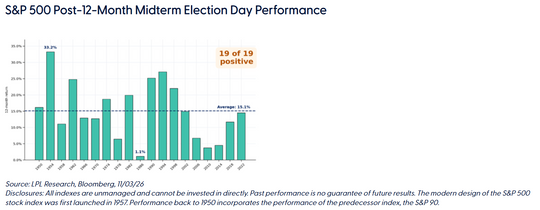
Since 1950, the S&P 500 has gained an average of 15.1% during the 12 months following a midterm election. Even the weakest post-midterm period still generated a positive return.
Of course, history never guarantees future results, but it does suggest that elections often remove an overhang that has been weighing on investor sentiment.
Don't Let Politics Drive Your Portfolio
Over time, the biggest drivers of market returns tend to be factors such as corporate earnings, consumer spending, inflation, and interest rates. credit conditions, federal Reserve policy and technological innovation and productivity growth.
Today, that list also includes AI, which is increasingly influencing economic growth, corporate profitability, and market performance.
For long-term investors, political views are generally best expressed at the ballot box, not through investment decisions. History has shown that markets have been capable of generating positive returns under many different political combinations because economic growth and corporate profits matter far more than party control over longer periods.
Our Bottom Line
From an investment perspective, there simply wasn't as much at stake in this election as some previous cycles. Divided government reduces the likelihood of significant policy shifts, and markets generally prefer predictability.
Looking ahead, we remain focused on several factors that we believe matter far more than election headlines: a still-resilient economy, the potential for inflation to continue easing after the new year, strong corporate earnings, and ongoing AI investment and adoption.
For now, however, the fundamentals remain the more important story for investors. As always, we are here for the conversation. Let us know if you want to schedule a call.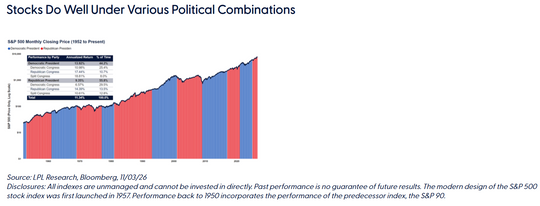
This material is for general information only and is not intended to provide specific advice or recommendations for any individual. There is no assurance that the views or strategies discussed are suitable for all investors. To determine which investment(s) may be appropriate for you, please consult your financial professional prior to investing.
Investing involves risks including possible loss of principal. No investment strategy or risk management technique can guarantee return or eliminate risk.
Indexes are unmanaged and cannot be invested into directly. Index performance is not indicative of the performance of any investment and does not reflect fees, expenses, or sales charges. All performance referenced is historical and is no guarantee of future results.
All information is believed to be from reliable sources; however LPL Financial makes no representation as to its completeness or accuracy.
Unless otherwise stated LPL Financial and the third party persons and firms mentioned are not affiliates of each other and make no representation with respect to each other. Any company names noted herein are for educational purposes only and not an indication of trading intent or a solicitation of their products or services.